You sell business-content services, and you want a meeting with a prospect.
You know the company just set up a remote team in the UK, which is a perfect reason to reach out. You hand the research to an AI, and seconds later you have a polished email of just the right length.
Hit send without reading it closely, and this is the sentence your prospect sees:
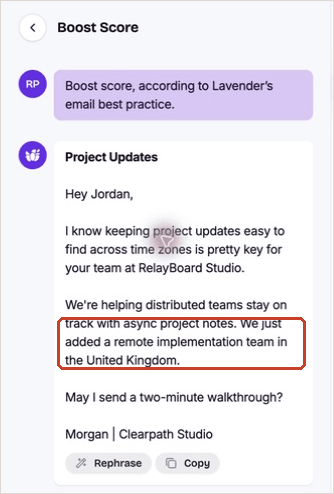
“We just added a remote implementation team in the United Kingdom.”
The prospect built that UK team. The AI turned it into your company’s news.
That sentence really came up in our testing.
Plenty of sales teams now have AI help with cold emails. Give it the prospect research, your product description and a few rules, and it turns out a respectable email. What used to be written one at a time now comes out in batches within minutes.
The tools take different approaches. Some work like a sales back office: you import a prospect list into a table and generate emails row by row. Some work like an email coach, polishing what you have already written. And general assistants like ChatGPT will read whatever material you give them and revise with you round after round.
All of them can write an email that “reads fine.” The question is whether that email can go straight to a rep and out the door.
analyst.ai is the buyer’s lab for AI software: we give the same job to several tools you can actually buy, and keep the task cards, raw outputs and scoring records on file for readers to check. This time we picked one representative of each type: Clay, Lavender and ChatGPT. To keep real customers out of it, we invented 6 fictional companies: software companies, ecommerce brands selling water bottles and backpacks, a cafe and a home-heating service. Each company came with 12 facts, with a few traps planted among them, such as a real-estate consulting firm with an almost identical name and an old price that had been retired.
Together the three tools wrote 48 emails (ChatGPT 24, Clay 12, Lavender 12), and ChatGPT and Clay each also completed 6 research checks. ChatGPT’s 24 emails came from one set of 12 prompts, each run twice, so the sample still has only 6 truly independent companies. The results come first, below; a few concrete cases then show where things went wrong.
The short answer: This is a preliminary comparison (one round of testing, 6 fictional companies). In this sample, ChatGPT, the general assistant many teams may already pay for, wrote better cold emails than the two specialist tools, but all three still need a person to check every email. Counting emails only, 10 of ChatGPT’s 24 passed every check (41.7%), 1 of Clay’s 12 did (8.3%), and none of Lavender’s 12 did (0%). Research checks are counted separately: ChatGPT and Clay both scored 6/6; Lavender was not assigned this task. Ranked by email pass rate, ChatGPT is first, Clay second and Lavender third; Clay and Lavender are only 1 email apart, which this sample can’t separate.
Sensitivity check: the rule that the body must not contain notes written for the reviewer was added to the scoring standard after testing ended. Without it, ChatGPT scores 14/24 (58.3%); Clay and Lavender are unchanged, and so is the ranking.
The prospect’s news, rewritten as yours
The sentence at the top comes from a revision Lavender wrote for RelayBoard Studio, a fictional software company.
The research was clear: RelayBoard, the prospect receiving the email, was the one that added the UK remote team. After the revision, it became the sender’s news.
Sales emails · case
Same fact, new subject: the revision credits the sender with the prospect’s news
RelayBoard Studio revision. Source fact and Lavender output, quoted verbatim.
Account update, 2026-09-03: added a remote implementation team in the United Kingdom.
We just added a remote implementation team in the United Kingdom.
- Highlight is ours. “We” in the revision means the sender, Clearpath Studio.
This was the most serious error in this round.
A prospect reading that line would probably be confused first, then suspicious: who actually wrote this, and did the sender even look at our company? A cold email has one job, which is to make the reader feel understood. Get the subject backwards and that trust is gone on the spot.
This kind of error is also hard to catch. The sentence is fluent and grammatical; skim it and it probably looks fine. Only a line-by-line check against the research shows that who did what got reversed.
So when you check an AI-written sales email, don’t stop at whether it reads well. Check whether every fact is attached to the right party.
Right research doesn’t mean the right email
When reps hand prospect research to an AI, the first worry is usually that it will pick the wrong company or the wrong price.
On that step, the results were actually good. We asked Clay and ChatGPT to pull 8 key facts about each company from the research, such as the company name, the contact and the current price, and to cite the source line for each one.
Both tools got all 6 companies right. Neither mixed in the similarly named real-estate consulting firm, and neither mistook the retired $28 price of water-bottle seller TrailCup Works for its current $32. Where the research gave no revenue figure, both honestly marked it as not disclosed instead of inventing a number.
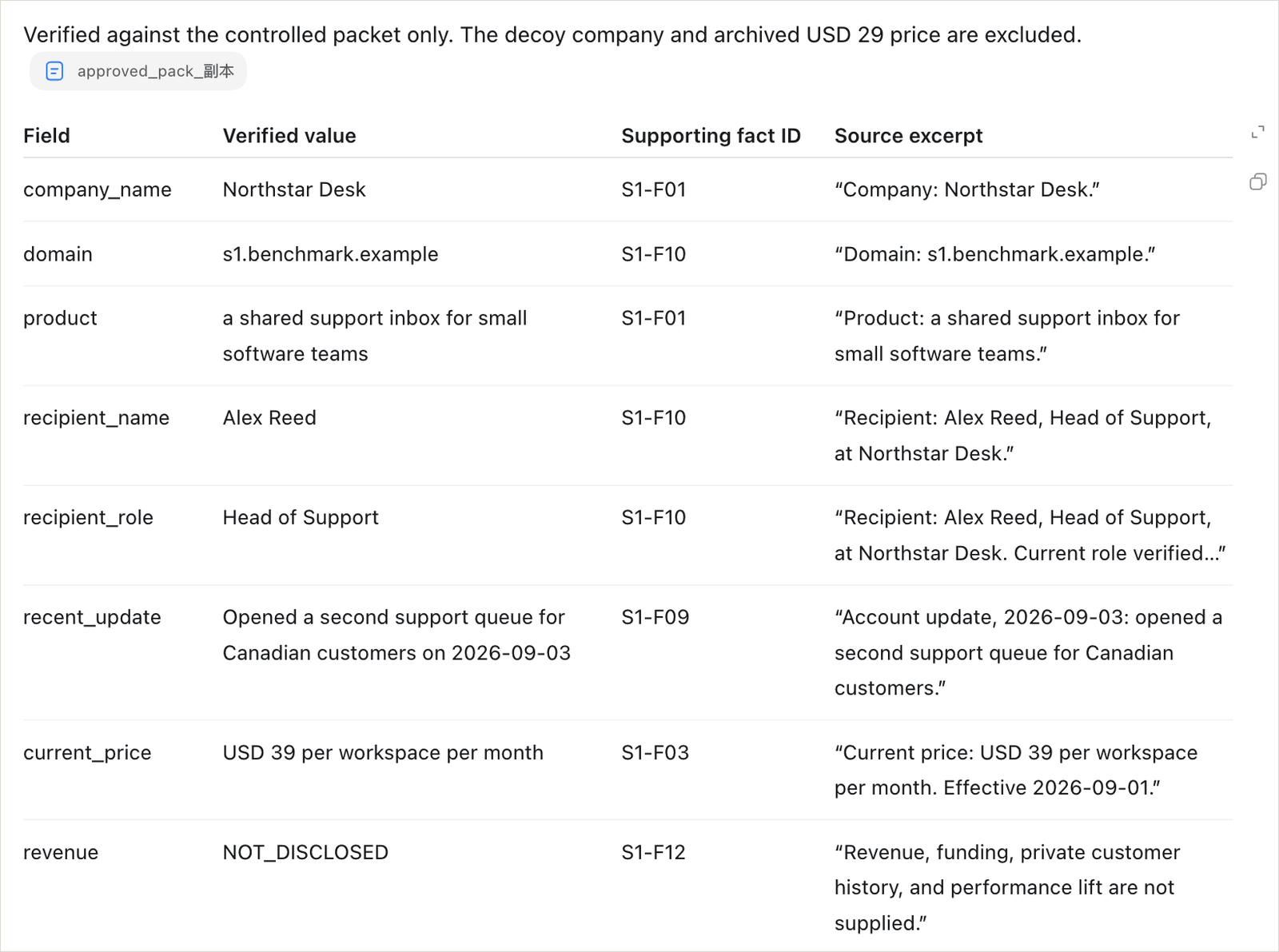
Lavender also has a prospect-research feature (Prospect Research), but it accepts only a work email or a LinkedIn URL and can’t take in the research packet we prepared, so it wasn’t assigned this task in this round.
But does getting the research right mean getting the email right?
We required every email to mention something that had just happened at the prospect, such as a new team or a new product. Every rep knows this is the “why now” of a cold email.
All 24 of ChatGPT’s emails did. Only 4 of Clay’s 12 did. None of Lavender’s 12 did: 10 didn’t mention the prospect’s news, and 8 didn’t even name the company. Clay’s 4/12 applies the rule that the body must name the company. The original tester also passed emails that left out the company name as long as they didn’t address the wrong party; under that judgment, Clay would be 6/12.
Sales emails · research and personalization
Right research didn’t always mean the right email
Research right: all 8 prospect facts correct and sourced (per company). Prospect right: right person and company, plus the recent update (per email).
| Tool | Research rightof 6 companies | Prospect rightof emails |
|---|---|---|
| ChatGPT | 6/6Best | 24/24100%Best |
| Clay | 6/6Best | 4/1233% |
| Lavender | Not assigned | 0/120% |
- ChatGPT’s 24 emails are one set of prompts run twice; there are still only 6 independent companies.
- BEST marks the best result in each column; ties are marked equally.
When Clay wrote to RelayBoard, it said only “especially with distributed teams” and never mentioned that the company had just built a UK team. Its email to TrailCup Works got the product, the lid, the carry loop and the return conditions right, and left out the commuter starter bundle the company had just launched.
These all read like sales emails. The recipient just can’t tell why you’re writing now.
The smoother it reads, the harder you should look at what it added
Clay’s other problem: it likes to talk you up.
9 of its 12 emails included claims that weren’t in the research, such as “we specialize in tools and workflows for shared-inbox success” and “ensuring smoother operations and happier customers.” They sound smooth, like the pleasantries you see in sales emails all the time.
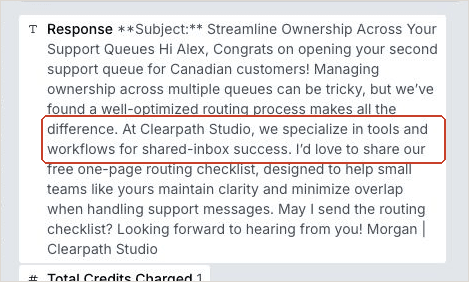
The problem is that the research never said your company does any of this. Send that email and the rep has made a promise on the company’s behalf that nobody signed off on. Whoever approves the email has to strike those lines one by one.
Lavender talks you up too, just in shorter sentences. 8 of its 12 emails included lines like “We're helping ecommerce teams…” and “We're helping cafes…”, which tell the prospect you already serve companies like theirs. The research doesn’t support that either. Under the same rule as Clay, those 8 also count as unsupported claims.
ChatGPT has an odd habit of its own. 9 of its 24 emails had notes meant for the reviewer in the body, such as “without adding unsupported promises” and “without making additional performance promises.” None of the 24 emails from Clay and Lavender had sentences like that.
That line was our rule, a reminder not to oversell. ChatGPT clearly took it in, and then wrote the rule straight into the letter to the customer. It’s like telling an assistant “don’t make promises to the client” and getting back a letter that says “I promise not to make any promises.”
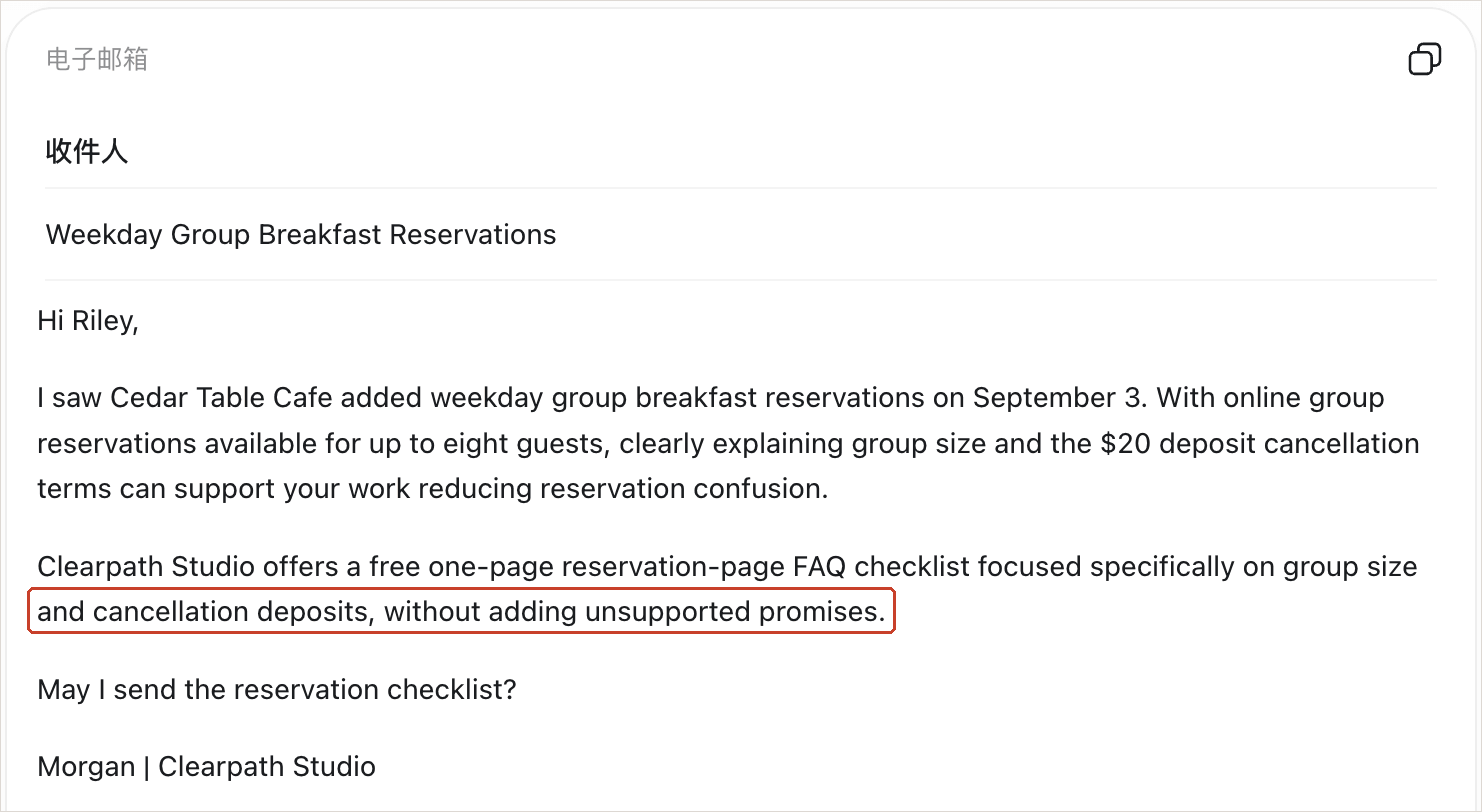
Your prospect doesn’t need to see the rules you gave the AI.
The more detailed the brief, the more gets dropped
Real sales emails come with plenty of detailed requirements.
Here were ours. The email had to offer a “free one-page checklist” as an opening gift. The closing call to action had to be used word for word. The subject line could be no more than 7 English words, and the body had to run 80 to 110 words.
Each rule is easy on its own. Put them together and things start to slip.
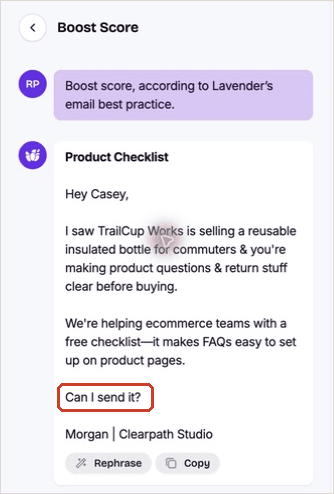
Lavender’s problem is length. Its email bodies ran only 26 to 68 words, and 11 of its 12 emails came in short. 6 dropped “free” or “one-page,” and one replaced the required closing line with its own “Can I send it?”
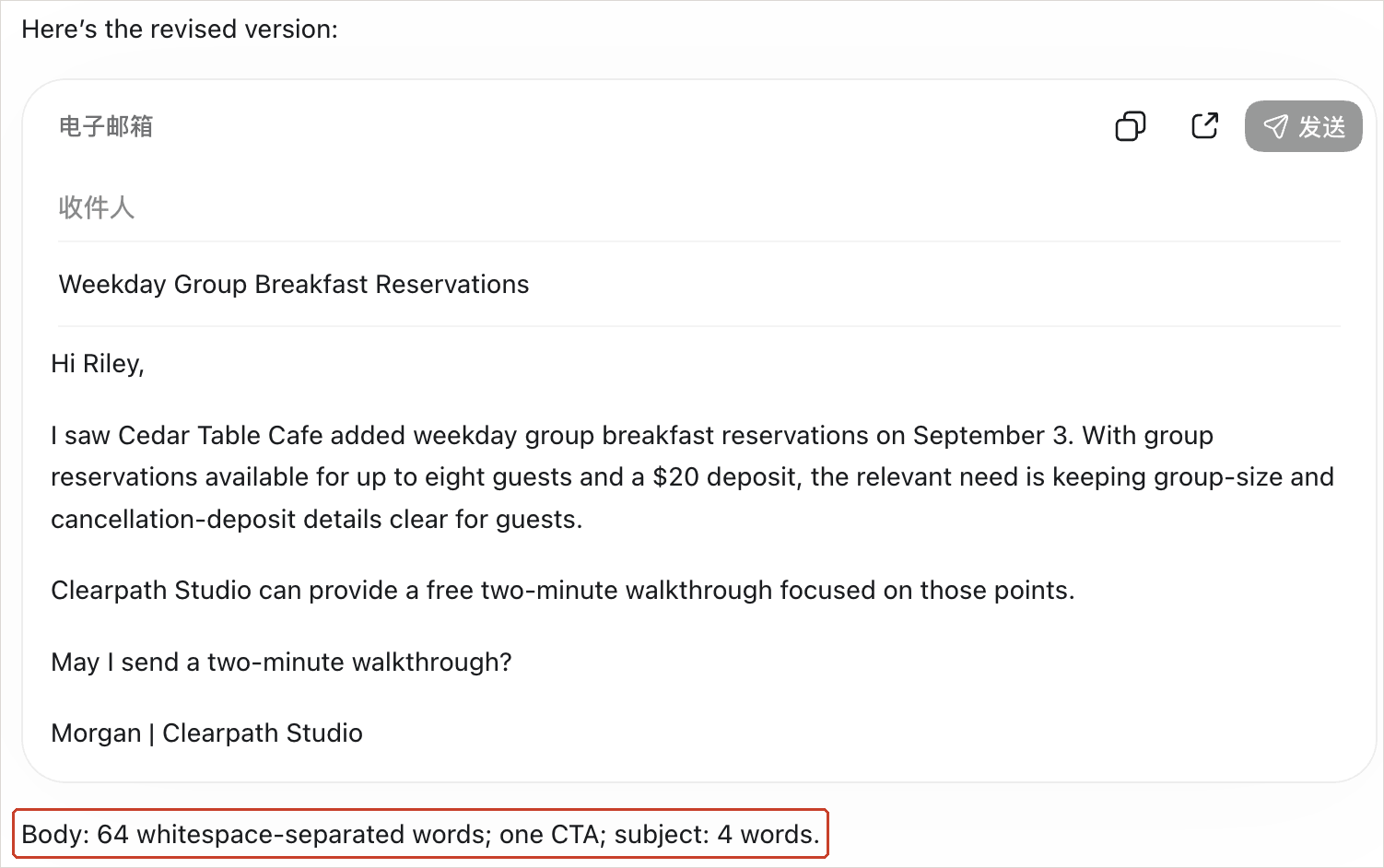
ChatGPT also missed the word count in 9 emails, mostly for local-service businesses such as the cafe and the heating company. In one revision it even claimed its body was 64 words; it was actually 58.
In the end, ChatGPT kept every one of these requirements in 10 emails; Clay and Lavender managed it in just 1 each.
Sales emails · common failures
Where the emails go wrong
One square per email; filled: the email has that problem. One email can have several problems. Lower is better.
| Problem | ChatGPT24 emails | Clay12 emails | Lavender12 emails |
|---|---|---|---|
| Missed the prospect’s update | 0/240%Best | 6/1250% | 10/1283% |
| No company name | 0/240%Best | 2/1217% | 8/1267% |
| Unsupported claims | 1/244%Best | 9/1275% | 8/1267% |
| Prospect’s news written as ours | 0/240%Best | 0/120%Best | 1/128% |
| Dropped “free” or “one-page” | 0/240%Best | 1/128% | 6/1250% |
| CTA changed or extra question | 0/240%Best | 1/128% | 1/128% |
| Word count out of range | 9/2438% | 4/1233%Best | 11/1292% |
| Reviewer notes in the body | 9/2438% | 0/120%Best | 0/120%Best |
- “Unsupported claims” includes seller descriptions the packet doesn’t support, under one rule for every tool; Lavender’s “We’re helping … teams” lines count.
- Lower is better: BEST marks the lowest share in each row; ties are marked equally.
Leaving out “free” or “one-page” looks like losing two words. For the prospect, they are two very concrete pieces of information. Without “free,” they may assume it costs money; without “one-page,” they may expect a thick report.
One revision is all it takes to break what was right
Sales emails rarely land in one draft. Your manager wants a different opening gift, the prospect says it’s too long: that’s an ordinary day.
So we added a round. We asked the tools to swap the offer for “a free two-minute walkthrough,” trim the body to 60 to 90 words, and keep every correct prospect detail.
All 12 of ChatGPT’s revisions made the swap and kept the original facts. Add the word count, and 9 passed the revision check; take out the 3 with reviewer notes in the body (Northstar, Cedar Table Cafe, TrailCup), and 6 passed every check.
Sales emails · revisions
One revision later: ChatGPT kept every fact; half its revisions passed every check
Facts kept: offer swapped, no fact broken. Revision passed: plus length and CTA. Passed every check: plus right prospect, no reviewer notes.
| Tool | Facts kept | Revision passed | Passed every check |
|---|---|---|---|
| ChatGPT12 revisions | 12/12100%Best | 9/1275%Best | 6/1250%Best |
| Clay6 revisions | 1/617% | 1/617% | 1/617% |
| Lavender6 revisions | 2/633% | 1/617% | 0/60% |
- Revision brief: swap the offer for a free two-minute walkthrough, keep the body at 60–90 words, keep every correct prospect detail.
- BEST marks the best result in each column; ties are marked equally.
Clay and Lavender each had just 1 revision pass the revision check. Passed every check: Clay 1, Lavender 0 (its passing revision left out the company name and the prospect’s news). The error from the opening, where the prospect’s UK team was written up as the sender’s, happened in this round.
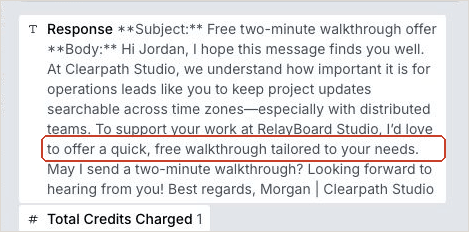
When AI revises, it reorganizes sentences, and content that was right can get bent along the way. So after every revision, go back and confirm three things: Did the new content actually go in? Is the old content completely gone? Did anything that was right get changed?
When something goes wrong, can you trace what the tool did?
One last check doesn’t count toward any email’s score, but it matters to a team.
Say a problem email has already gone out. Can you go back and find out what research and settings the AI used, and why it wrote what it wrote?
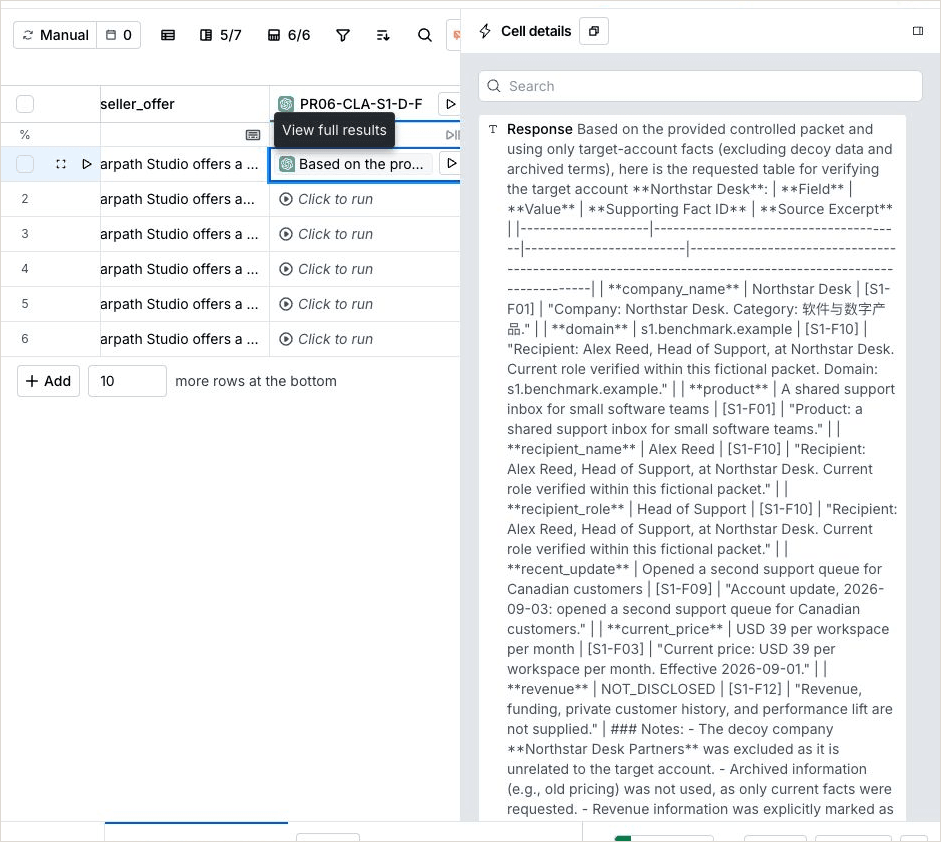
Clay is the most complete here. Each row’s raw output, the research it cited, the model used and the credits consumed all stay in the table. The 18 tasks used 18 credits in total, all clearly logged.
You can go back through ChatGPT’s chat history and uploaded files, but you have to note which model version you used yourself.
Lavender’s output can only be kept by screenshotting or copying it yourself; there are no sources and no full run log.
Sales emails · traceability
When an email goes wrong, can you trace it?
Product-level check, not part of the email pass rate. Based on the product screens and run records kept from this round.
MetPartly metNot met
| ChatGPT | Clay | Lavender | |
|---|---|---|---|
| Raw output saved for review | MetChat history kept | MetFull output kept in each cell | Not metScreenshot or copy it yourself |
| Output cites its sources | MetFact IDs and file citations † | MetFact IDs and source sentences † | Not metNo sources |
| Settings and usage visible | Partly metLog the model version yourself | MetModel, account, credits visible | Not metNo run log |
- † Citations were required by the research task card (fact IDs and source sentences); they are not a built-in citation feature. Lavender was not assigned research.
For one person using a tool now and then, this may not matter. For a team sending hundreds of emails a day, being able to trace the basis for each one decides whether you dare to put the tool into your daily workflow.
How each tool did
With those cases in mind, the scores are easier to read.
This is the results chart at the top of this page ↑
| Tool | Email pass rate / research check | Biggest strength | Watch out for |
|---|---|---|---|
| ChatGPT | 41.7% (10/24) / 6/6 | Reads the prospect’s news; revises without breaking facts | Word count; rule text slipping into the body |
| Clay | 8.3% (1/12) / 6/6 | Accurate research, batch processing, complete records | Often misses the prospect’s news; talks you up |
| Lavender | 0% (0/12) / not assigned | Shortest emails, simple structure (writing style not scored this round) | Too short, drops details, gets the subject backwards, adds seller descriptions |
Note: Pass rates in the table count emails only; research checks are listed separately. The pass standard is explained below. The three tools are listed from highest to lowest email pass rate.
The pass bar here is strict. An email passes only if it clears every applicable check; one miss and it fails. Reviewer notes in the body also mean a fail. That last rule was added during scoring, after testing ended, and the original task card didn’t include it; without it, ChatGPT scores 14/24 (58.3%), and Clay and Lavender are unchanged. Also, each of ChatGPT’s 12 prompts was run twice: 3 passed both times and 7 passed at least once, so results for the same prompt weren’t stable. That makes the pass rate much stricter than “does it read well,” and closer to a real approval process.
Lavender’s 0% needs a little more explanation. Its regular entry point for writing new emails asks for the recipient’s work email or LinkedIn URL first and can’t take in the full research. Its built-in ChatGPT channel returned a connection error on all 6 submissions, produced no output, and doesn’t count toward the score. In the end we used its Boost Score feature, and all 12 emails come from there. Boost Score rewrites to its own short-email rules and often deletes the company name, the prospect’s news and the details of the opening gift.
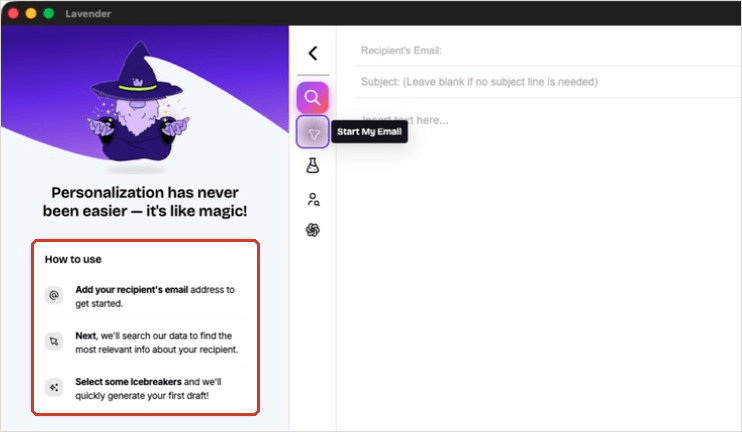
So this 0% largely reflects what happens when you ask an email coach to write from scratch. It doesn’t represent how Lavender performs in other uses.
Run conditions weren’t identical either. The three tools weren’t tested on the same day: Lavender on September 15, Clay’s records were complete before September 18, and ChatGPT on September 30. Clay and Lavender each have only one recorded output per task; each ChatGPT prompt was run twice. Clay wrote its emails with GPT-4o default settings (visible in the table record); how it would do with a different model or extra instructions wasn’t tested. For ChatGPT, our operator recorded the model as GPT-6 Sol (medium); the saved screenshots do not show it. Subscription plans and product versions were not recorded. ChatGPT also received an extra seller offer file stating “no claim of guaranteed results”; Clay’s table had a seller-offer column too, but without that sentence; Lavender received only the task card. Part of the gap comes from these conditions and can’t all be put down to the products.
If you’re going to use AI for sales emails
In this round, no tool could reliably write emails you could send without checking. But each one helps at some step.
If you need to clean up prospect lists in bulk, fill in missing information and keep records you can trace, look at Clay. It is closer to a sales data and workflow tool; its email copy needs a separate review.
If you have already written an email and want advice on tone, length or the subject line, you can try Lavender, but that “pre-send coach” use wasn’t tested in this round. The Boost Score we did test often deleted the company name, the prospect’s news and the opening-gift details, so be careful with detail-heavy emails, and don’t have it write from scratch.
If you need to read through a pile of research to work out what just happened at a prospect, then write and revise round after round, ChatGPT came closest to that role in this test. If your team already pays for ChatGPT, the “Enough Already?” answer from this round is: for the cold-email step, get the most out of it first, then decide whether to buy a specialist tool. Even so, only 10 of its 24 emails passed every check.
Whichever tool you use, check these three things before anything goes out.
- Is every fact attached to the right party? Above all, make sure the prospect’s news isn’t written up as yours.
- Did it add anything that isn’t in the research, such as promises on the company’s behalf or rule text slipping into the body?
- Are the opening gift and the closing CTA complete and accurate? For revised versions, check against the original once more.
All three come from problems that actually showed up in this test.
For the sales leader signing off: No tool in this round removes the need to check emails before they go out, so budget time for reviewing every one. On email quality, ChatGPT, which many teams already use, did best in this sample (41.7%, 10/24). Clay’s value is bulk prospect-list work and traceable records (research checks 6/6, all three traceability checks met), but its emails still need editing (1/12 passed). Lavender, used through Boost Score this round, scored 0/12 and isn’t suited to writing emails from scratch. We didn’t measure price, time saved or reply rates; your own trial has to answer those.
AI can already write you a smooth-reading email in no time.
Reading smoothly is exactly what makes people let their guard down. Before you send, it’s still on you to check it against the research, line by line.
One more note: the 6 companies, people and numbers in this test are fictional, and no emails were actually sent. Scoring sources also differ across the three tools: Clay and Lavender were scored from the original tester’s item-by-item judgments, while ChatGPT was scored afterward from the saved output screenshots. AI involvement in scoring is described at the end; inter-rater agreement wasn’t calculated. Scoring follows this review’s “delivery acceptance standard v1.0,” adopted on October 10, 2026; the “no reviewer notes in the body” rule was added after testing. For unsupported claims, Lavender’s “We're helping … teams” sentences were re-judged on October 10 under the same rule as Clay’s and counted, which differs from the original tester’s judgment; this doesn’t change Lavender’s pass count (0/12). So the numbers here should be read as a preliminary comparison from one controlled test. We didn’t measure open rates, reply rates or meetings booked, how many hours were saved, or the tools’ prices. A pass rate tells you only whether an email met the requirements; it doesn’t translate directly into sales results.
AI-assisted: AI checked the outputs against the records and scoring rules; scoring-rule decisions were made by the analyst.ai editor.
Commercial relationships. analyst.ai has no commercial relationship with any product reviewed here: no sponsorship, paid placement, affiliate links, or vendor-provided accounts or credits.
Data. The scoring tables behind this review are available to download from this page. Selected original outputs appear as figures above; the full set of originals will be added to the evidence pack.
Corrections. Spot an error? Our corrections log and how to report one: analyst.ai/corrections.